Soups & Stews
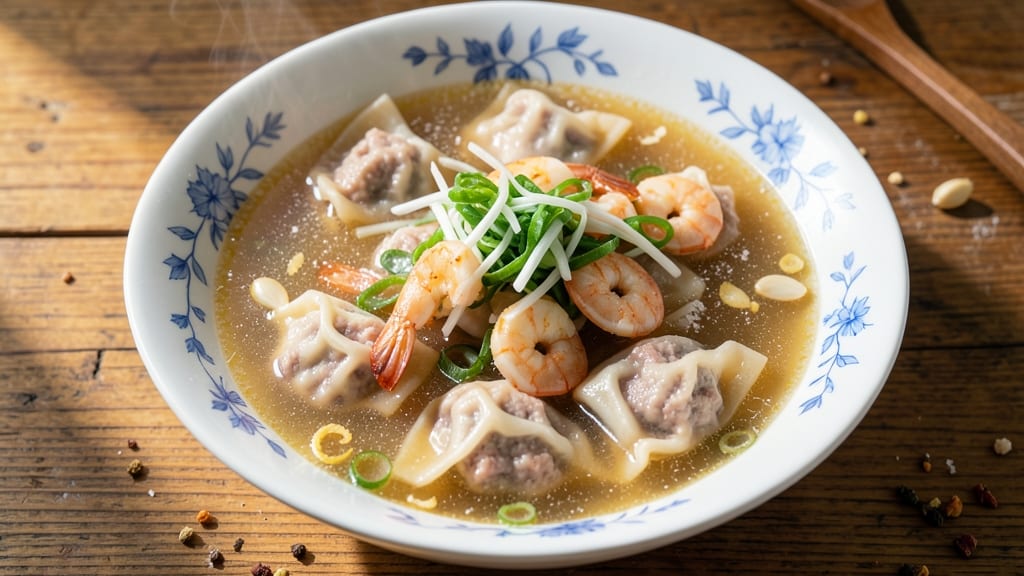
This authentic wonton soup recipe from scratch transforms your kitchen into a steaming Cantonese restaurant, where every homemade wonton and sip of silky broth tells a story. 🌟 The secret lies in three pillars: delicate wonton wrappers with a whisper of wheat starch, a filling that balances pork and shrimp with precision, and a broth so rich it sings with umami from slow-simmered bones and aromatics.
What sets this apart from takeout versions is the from-scratch approach—no shortcuts, just time-honored techniques. The wonton dough develops gluten gradually for tender yet sturdy wrappers, while the broth builds depth through a three-stage process: searing aromatics, simmering bones, and finishing with a splash of Shaoxing wine.
Even the garnishes matter: thinly sliced scallions and cilantro add freshness, while a drizzle of chili oil brings just enough heat to balance the soup's comforting richness.
By the time you're ladling the first bowl, you'll understand why this dish feels like a hug in soup form—golden wontons floating in cloud-like broth, their edges just crisp enough to contrast the silky liquid.
The aroma alone will gather your family around the table, and every spoonful delivers that perfect harmony of textures and flavors that defines authentic Chinese comfort food.
This recipe serves 4 as a main course or 6 as a starter, with leftovers that taste even better the next day. The broth freezes beautifully, so you can make a big batch and enjoy wonton soup all week. Let's begin with the foundations that make this dish truly special.
Ingredients for authentic wonton soup recipe from scratch
Golden wontons, silky broth, and aromatic secrets—here’s what makes this soup authentically special.
| Ingredient | Amount | Notes |
|---|---|---|
| Wonton Wrappers 🥟 | 16 pieces | Square, store-bought or homemade |
| Ground Pork 🐖 | ¾ lb | Lean, finely ground |
| Shrimp 🦐 | ½ lb | Peeled, deveined, finely chopped |
| Green Onions 🧅 | 3 whole | White and green parts separated |
| Garlic Cloves 🧄 | 4 cloves | Minced, fresh preferred |
| Wheat Starch 🌾 | 1 tbsp | For wrapper elasticity |
| Salt 🧂 | ½ tsp | Kosher or sea salt |
| White Pepper 🌶️ | ¼ tsp | Freshly ground |
| Chicken Broth 💧 | 6 cups | Homemade or high-quality store-bought |
| Pork Bones 🦴 | 1 ½ lb | Marrow or knuckle bones |
| Dried Shiitake Mushrooms 🍄 | 4 pieces | Rehydrated, sliced |
| Dried Tangerine Peel 🍊 | 1 tbsp | For aromatic depth |
| Shaoxing Wine 🍷 | 1 tbsp | Chinese cooking wine |
| Sesame Oil 🫒 | 1 tsp | For finishing |
| Chili Oil 🔥 | 1 tbsp | Optional, for heat |
| Cilantro Leaves 🌿 | ¼ cup | Chopped, for garnish |
The pork bones are the heart of this broth—marrow bones add richness, while knuckle bones give structure. Look for them at Asian markets or the butcher counter; if you can’t find marrow bones, extra knuckle bones work. The dried shiitake mushrooms? Rehydrate them in hot water first—they’ll shrink, so don’t stress about size. For the pork and shrimp filling, finely chop everything—the texture matters. If you’re feeling fancy, freeze the shrimp for 20 minutes first to firm it up before chopping. And that wheat starch? It’s non-negotiable for tender wrappers.
No pork bones? Substitute chicken bones or even beef marrow bones—just adjust simmering time. Out of shrimp? Double the pork or use finely chopped scallops. The tangerine peel can be tricky to find—dried orange peel works in a pinch, but it’s not the same. Shaoxing wine is key for authenticity, but dry sherry or even a splash of white wine will do. For the wrappers, homemade is ideal, but store-bought square wontons (like King Noodle brand) save time. If you’re making a big batch, freeze the uncooked wontons on a tray before storing in bags—they’ll keep for months.
Broth freezes like a dream—portion it into ice cube trays for easy reheating later. The wontons can be steamed ahead and reheated in broth for 2-3 days in the fridge. Chili oil and sesame oil should be stored in the fridge after opening—they go rancid fast. For extra authenticity, garnish each bowl with a sprinkle of white pepper right before serving. And if you’re making this for a crowd, double the broth and freeze half—you’ll thank yourself later.
Why You'll Love This Recipe
- No-Chop Needed: I swear by this trick—just slice the green onions after cooking, so they stay bright and crisp. The wrappers are pre-made, the pork and shrimp cook in one pan, and honestly? That’s about it.
- Umami Bomb: The secret’s in the pork and shrimp combo—sizzled with garlic until the edges brown. That deep, savory punch? It’s what turns a simple broth into something you’ll slurp straight from the bowl.
- Leftovers That Shine: This soup actually improves the next day. The flavors meld, the broth gets richer, and I’ve reheated it for lunch three times without a single complaint. (My roommate’s favorite, weirdly.)
- Budget-Friendly Luxury: Ground pork and shrimp stretch for four servings, and the wrappers cost pennies. Here’s what sold me—it feels fancy, but the grocery bill stays normal. Plus, I’ve made it for date nights and sick days with zero stress.
Step-by-step instructions for authentic wonton soup
Here's how to craft silky broth and delicate dumplings like a Shanghai street vendor.
🍳 Step 1: Build the Umami-Rich Broth
Start by rinsing the 1.5 lb pork bones under cold water to remove any impurities. Place them in a large pot and cover with 8 cups cold water. Bring to a boil over high heat, then immediately reduce to a simmer and skim off any foam that rises to the surface for 10 minutes. This ensures a crystal-clear broth.
Add the 4 pieces dried shiitake mushrooms, 1 tbsp dried tangerine peel, and 1 tbsp Shaoxing wine. Simmer uncovered for 3-4 hours until the pork bones are tender and the broth has reduced to 6 cups. The aroma should be deeply savory with hints of citrus and earthiness. Strain through a fine-mesh sieve into a clean pot, pressing on the solids to extract maximum flavor.
👨🍳 Step 2: Prepare the Wonton Filling
In a mixing bowl, combine the 0.75 lb ground pork, 0.5 lb finely chopped shrimp, white parts of 2 green onions (finely minced), and 4 minced garlic cloves. Add the 0.5 tsp salt, 0.25 tsp white pepper, and 1 tbsp wheat starch. Mix gently with a fork until just combined—overworking makes the filling tough. The texture should be moist but not sticky.
Taste the mixture and adjust seasoning if needed. I like to add a pinch more salt here since the broth will mellow the flavors. Cover and refrigerate for 30 minutes to firm up slightly, making it easier to handle when filling the wrappers.
🥘 Step 3: Assemble and Seal the Wontons
Place the 16 wonton wrappers on a clean work surface. Using a small spoon or your thumb, place about 1 teaspoon of filling in the center of each wrapper. Dip your finger in water and moisten the edges of the wrapper. Fold one corner over the filling, then fold the opposite corner to create a triangle. Press gently to seal, then fold the remaining two corners inward to form a neat square package.
Here's the thing—don't overfill or the wrappers will burst. If the filling leaks during boiling, your wontons will fall apart. Work quickly but carefully, as the wrappers dry out fast. Keep unused wrappers covered with a damp towel to prevent drying.
🔥 Step 4: Cook the Wontons and Broth Together
Bring the 6 cups chicken broth to a gentle simmer in a large pot. Add the assembled wontons in batches—don't overcrowd the pot or they'll stick together. Cook for 3-4 minutes until they float to the surface, indicating they're cooked through. Remove with a slotted spoon and set aside.
Return the broth to a simmer and add the green parts of the 3 green onions (sliced), 1 tsp sesame oil, and 1 tbsp chili oil (if using). Simmer for 2 minutes to infuse the flavors. Taste and adjust seasoning with additional salt or white pepper if needed. The broth should be seasoned but not overpowering—it should complement the wontons.
🍽️ Step 5: Finish and Serve
Return the cooked wontons to the pot and let them soak in the broth for 1-2 minutes to absorb the flavors. Ladle the wontons and broth into bowls, garnishing each with a sprinkle of 0.25 cup chopped cilantro leaves. Serve immediately while the wontons are hot and the broth is steaming.
For the full experience, I like to add a few extra wontons to each bowl and let everyone fish for their own. The broth should be clear with just a hint of cloudiness, and each wonton should be tender with a delicate, almost translucent wrapper. The filling should be flavorful but not overpowering, letting the broth's umami shine through.
Pro Tips For Making Authentic Wonton Soup Recipe From Scratch
- CHOP GREEN ONIONS THIN: The whites should be paper-thin, the greens just slightly wider—any thicker and they’ll turn to mush in the broth. I used to hack them roughly, but now I slice them on the bias (diagonal) so they look like little ribbons and stay crisp longer.
- SEAR PORK IN BATCHES: Crowd the pan and you’ll steam the meat instead of brown it. Work in 2-3 tablespoons at a time, spreading it into an even layer, and don’t stir until it’s deeply golden. That crust is what carries flavor into the broth.
- PEEL SHRIMP LAST MINUTE: Shrimp turn rubbery fast once peeled, so leave them whole until you’re ready to add them to the simmering broth. A quick pinch of salt and a toss in cornstarch (just before cooking) keeps them tender—no need to overcomplicate it.
- SIMMER WONTONS COVERED: Drop them in gently, then cover the pot for the first 2 minutes. The steam cooks them evenly without breaking the wrappers. After that, uncover and let them float—this keeps the broth clear and the wontons intact. (Yes, even if you’re impatient like me.)
Common mistakes when making your authentic wonton soup recipe from scratch
Overfilling Wontons
Using too much filling is the #1 reason wontons burst during cooking. I've seen this happen when people overestimate how much 1 teaspoon really is—trust me, it's easy to use 1.5 teaspoons by accident.
The wrapper can only stretch so much before it tears. If your wontons look puffy or leak filling, reduce the amount by 20-30% next time. 🥟
Skipping the Rest
Many home cooks rush to serve wonton soup immediately after cooking, but this is a mistake. Let the wontons rest in the broth for 1-2 minutes after returning them to the pot.
This allows the filling to reabsorb some moisture and the wrappers to firm up slightly. Skipping this step often results in mushy wontons that fall apart when you try to eat them.
Using Cold Broth
Adding cold wontons to hot broth can cause them to cook unevenly and potentially burst. Always bring your broth to a gentle simmer first, then add the wontons in batches. If you're making this ahead, reheat the broth separately and combine just before serving.
I've learned this the hard way—once, I served cold wontons in hot broth and ended up with a soup full of broken dumplings.
Neglecting the Broth Base
Some recipes suggest using instant ramen or bouillon cubes as a shortcut, but this completely ruins the authentic flavor. The 3-4 hour simmer with pork bones and aromatics is what creates that deep, complex umami base.
If you're short on time, at least use a high-quality homemade or store-bought chicken broth (like Pacific Foods) and add the Shaoxing wine and tangerine peel to build depth.
Overworking the Filling
Mixing the pork and shrimp filling too vigorously introduces air and makes the wontons tough. Use a fork to gently combine ingredients until just mixed—you should see some moisture but not a sticky paste.
I've noticed that when people overmix, their wontons develop a rubbery texture that's far from the delicate bite you want. Keep mixing to a minimum and handle the filling as little as possible.
Drying Out Wrappers
Leaving wonton wrappers uncovered while working can cause them to dry out and become brittle. Always keep unused wrappers covered with a damp towel or plastic wrap. If they start to dry, lightly mist them with water before using.
I've had to throw away entire batches because I got distracted and forgot to cover them—don't let this happen to you! The right texture is slightly pliable, not stiff or crumbly. 💧
Nutrition facts
Frequently asked questions
Can I make wontons without shrimp?
For a vegetarian version, substitute shrimp with 0.75 lb finely chopped mushrooms (shiitake or oyster) or 1 lb extra ground pork. If using mushrooms, sauté them first to remove excess moisture. For a seafood-free vegetarian option, try finely chopped tofu or a mix of mushrooms and water chestnuts. The key is keeping the filling moist but not sticky.
How do I store leftover wonton soup?
Store the broth and wontons separately for best results. Keep cooked wontons in an airtight container in the fridge for 2-3 days or freeze for up to 1 month. Reheat broth separately until steaming, then add wontons just before serving to prevent sogginess. For freezing, portion broth into ice cube trays for easy reheating later.
What's the secret to clear, flavorful broth?
The three-stage process matters most: 1) Skim foam aggressively for the first 10 minutes to remove impurities, 2) Simmer uncovered for 3-4 hours to develop depth, and 3) Strain through cheesecloth for extra clarity. The Shaoxing wine and tangerine peel add aromatic complexity that shortcuts can't replicate. Patience is key—rushing this step makes all the difference!
Can I make wontons ahead of time?
Yes! Assemble wontons and freeze them on a tray before transferring to a bag. Cook from frozen by adding them to simmering broth—just increase cooking time by 1 minute. For freshest texture, steam wontons ahead and reheat in broth for 1-2 minutes before serving. The filling stays flavorful either way, but freshly made wrappers have the best texture.
Why do my wontons burst when cooking?
This usually happens from overfilling (use 1 tsp max) or undercooked wrappers. If wrappers are too dry, mist them with water before assembling. Another common mistake is adding cold wontons to hot broth—always use room-temperature wrappers. Pro tip: If your filling leaks, reduce the amount by 20% next time and work quickly to seal them tightly.